LinkedIn
 X
X Building a big game roster: The game plan, playbook, and roster model for AI agents


Every championship game coach knows the secret: you need more than talent to win it all. You need a game plan, a playbook, and the right roster. The same idea applies to AI agents.
Building great AI agents is a lot like building a championship team. This framework represents the Tasks-Skills-Tools model, which breaks things down into three simple layers: what the team is trying to accomplish (Tasks, or the Game plan), how they approach the work (Skills, or the Playbook), and what they can interact with (Tools, or the Roster). Just as elite sports organizations don’t conflate their season goals with their play designs or their roster, successful championship team architectures keep these layers clearly separated—making teams easier to manage, more flexible to evolve, and better performers overall.
Championship challenge
As teams transition from preseason scrimmages to the regular season, coaching staffs face a recurring challenge: how do we build a roster and playbook that are maintainable, adaptable, and ready to scale for a championship run?
Early-season struggles reveal a familiar pattern. Teams try to cram everything into a single game plan, mixing offensive philosophy, defensive schemes, and roster decisions into a tangled mess. The result? Confusion that piles up quickly, coaching gaps that create risk, and roster challenges that limit championship potential.
This situation is so similar to how professional football has evolved over time. From the early gridiron days to the development of the forward pass and the rise of specialized positions, all shared a common root cause: insufficient separation of concerns. In each case, the solution was a clear organizational model that separated responsibilities and set patterns for how the pieces worked together.
Tasks-Skills-Tools model
This framework provides a clear organizational playbook for championship teams. It breaks down team capabilities into three separate areas of focus:
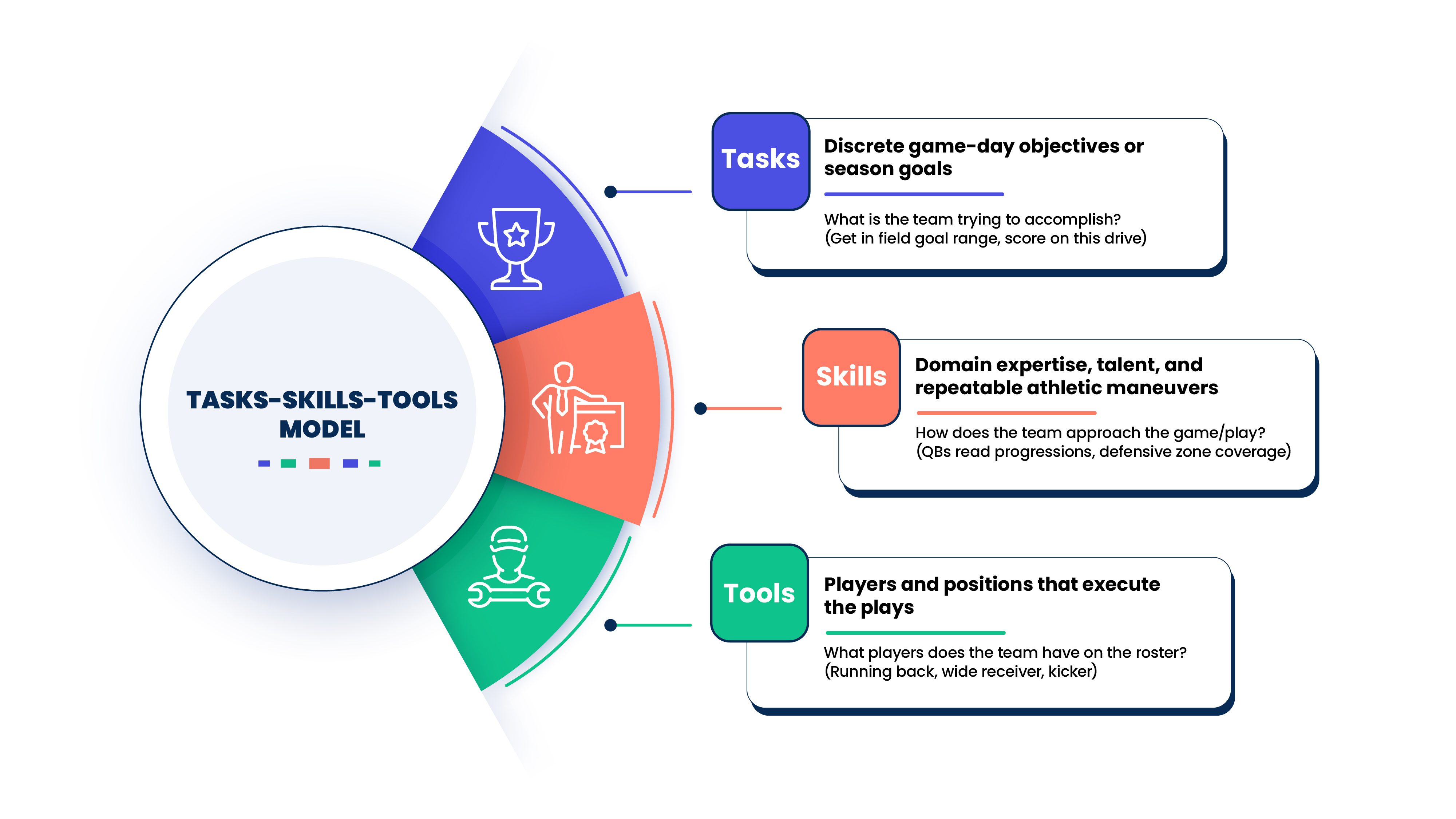
The three layers
Tasks: Game plan layer
A Task is a single play in the game plan, a specific, measurable objective for a player or the entire team. Simply put, Tasks answer the question: What is the team trying to accomplish?
Think of Tasks as the contract between the coach and the team. They translate the high-level objective, like winning the game, into actionable steps that can be practiced, executed, and evaluated.
Characteristics of well-defined tasks
The following are the key characteristics of well-defined tasks:
- Boundedness (clear scope): Each play has a clear start (the snap) and end (tackle, score, or incomplete pass).
- Measurability (success criteria): A task has defined success metrics, such as a completion rate, a specific yardage gain, or a goal scored. Vague outcomes, like "play well," do not count. Specific outcomes, like "convert on third down with 4 yards to go," do.
- Independence (modularity): While plays (tasks) can be combined into drives (workflows), each play should be independently executable and testable in practice.
Examples
The following table shows examples of well-defined tasks across different domains, along with their inputs, outputs, and success criteria:
| Domain | Task Example | Inputs | Outputs | Success Criteria |
|---|---|---|---|---|
| Offense | Execute "4-3 Dive" play | Down/Distance, defensive alignment | Yardage gained, first down status | Gain 4 or more yards and maintain possession |
| Defense | Force a turnover | Offensive Formation, Down/Distance | Interception or fumble recovery | Turnover secured |
| Training | Optimize recovery routine | Athlete biometrics, schedule data | Customized regimen, rest period | Reduced recovery time |
Coaching staff oversight
Tasks represent the interface between team capabilities and the season's objectives. They require oversight from the front office and coaching staff, addressing questions like:
- Who owns the play design?
- What is the review process for new schemes?
- How are play outcomes audited, such as through game film review?
Skills: Playbook and talent layer
A Skill is the domain knowledge, expertise, and reasoning patterns that let a team execute tasks effectively. Skills answer the question: How does the team approach the work? A generic athlete may have broad abilities, but they lack the specialized techniques needed for expert performance in a specific sport. Skills fill this gap by bringing domain expertise (the playbook) into the team's decision-making process.
How the team shows its skills
Skills can be implemented through complementary mechanisms:
-
Film study: Access domain-specific information, like historical opponent tendencies, retrieved based on context. This is effective for analyzing large libraries of game film.
-
Practice drills: Demonstrates correct techniques, such as perfect two-minute drills. This improves nuanced execution and stylistic consistency.
-
Muscle memory/drills (game-ready conditioning:) Encode domain expertise through repeated practice. This enables high-volume, split-second reactions on the field.
Rookie vs. Veteran performance
The distinction between a skilled and an unskilled team is substantial.
- Generic team: Executes a play using raw athletic ability. The result appears plausible but may miss a defensive rotation or apply incorrect blocking logic.
- Skilled team: Applies specialized expertise. Recognizes pre-snap reads, applies coverage rules correctly, and identifies patterns that warrant an audible.
Building the team playbook
Skills capture institutional knowledge, like a coaching philosophy. A well-developed skill, such as a patented defensive scheme, can serve multiple plays and athletes, and evolve over time.
Tools: Roster and positions layer
A Tool is a player on your roster with a specific position and skill set. A running back lets you execute run plays. A wide receiver opens up the passing game. A kicker gives you field goal range. Tools answer the question: who do you have on the field to execute the play?
Tools correspond to the players and positions that give teams their capabilities, the specialized roles on your roster that let you execute different types of plays and respond to different game situations.
Roster management
Tools share a lot in common with managing a football roster:
- Position availability: Which positions are filled on your roster? Can you run a 4-WR set, or only two receivers? The plays you can run depend on who’s available.
- Player utilization: Track which players see action and when, who’s getting snaps, and in what situations? Who is being used effectively versus sitting on the bench?
- Depth chart: What happens if your starting running back goes down? Is there a backup ready to step in, or does the whole run game stall?
Position types
Next, let’s break down the types of players on your roster and what roles they play:
| Category | Examples | Characteristics |
|---|---|---|
| Ball carriers | Running back, fullback | Execute ground game, short-yardage situations |
| Pass catchers | Wide receiver, tight end | Create separation, extend the field vertically |
| Blockers | Offensive linemen, fullback | Create running lanes, protect the quarterback |
| Specialists | Kicker, punter, long snapper | Field goals, punts, kickoffs, situational scoring |
How the game plan, playbook, and roster work together
Running the offense: how the layers connect
The power of the framework emerges from understanding how the layers interact:
-
Tasks orchestrate: They define the game plan and coordinate how skills and tools are applied.
-
Skills inform: They provide the talent and reasoning patterns that determine how the play is executed.
-
Tools enable: They are the players on the field who run the plays. Without a running back, you can't run. Without a receiver, you can't pass deep.
When the play breaks down
The following table helps explain how incomplete game plans fall apart and why all three layers are necessary:
| Configuration | Result |
|---|---|
| Task without Skills | Generic, error-prone performance. The team knows the play but not how to execute it with precision. |
| Task without Tools | Broken play. The coach calls a quarterback keeper, but there are no blockers on the field to protect the quarterback. |
| Skills without Tasks | Capability without direction. Expert talent sits unused because there is no game plan to apply it to. |
| Tools without team management | Risk exposure. Access to sensitive athlete data without accountability or control. |
From playbook to player autonomy
Coaching style: Play-calling vs. Player freedom
The Tasks-Skills-Tools framework describes what a team can do. There is another crucial dimension to consider, though: how much autonomy does a player have to make decisions on the field? This maps to two key coaching philosophies:
-
Game plan autonomy (task direction): How much does the coach call every play versus letting the quarterback audible at the line? A high-autonomy agent selects its own objectives, while a low-autonomy agent executes predefined plays.
-
Roster access autonomy (resource access): Can the team use any player on the roster, or only those the coach puts on the field? This determines how freely an agent can discover and use available tools.
Talent vs. Trust: Capability vs. Configuration
There is an important distinction between what a player can do, their talent or capability, and how much freedom they are given to use it, their trust or configuration. A star quarterback with a comprehensive playbook and the best players on the roster may still be configured to run only the plays the coach calls. Conversely, a backup player with limited skills might be given full autonomy within a narrow role.
This separation enables smarter team management. You can build the most capable roster possible, then configure trust levels based on game situations, opponent matchups, and risk tolerance.
Building your championship team
Development priorities
To build a team that actually wins, start with these development priorities.
- Begin with Tasks (Game plan): Clearly define the outcomes you want the team to achieve, such as winning the quarter or shutting down the opposition’s star player.
- Invest in Skills early (Playbook): Skills, including coaching expertise and athlete talent, represent captured institutional knowledge that compounds over time.
- Standardize Tools (Roster): Build integrations with key systems once, for example, game film systems, and share them across all athletes and coaches.
Team management model
Each layer requires its own approach to ownership, review, and oversight to support effective team management:
| Layer | Ownership | Review Process | Audit Focus |
|---|---|---|---|
| Tasks | Coaching staff and front office | Review for game relevance and feasibility. | Game outcomes and performance metrics. |
| Skills | Domain experts, such as positional coaches | Expert review for technique accuracy. | Applied knowledge and decision-making in the field. |
| Tools | Roster management and Position coaches | Roster availability and position depth review. | Player utilization, position coverage. |
The two-minute drill: key takeaways
Quick summary for the time-pressed reader, here’s the game plan:
-
Tasks = Game plan: Define clear objectives with measurable outcomes. What exactly is your championship team trying to accomplish?
-
Skills = Playbook: Invest in coaching experience and game strategies. How does your team approach the work?
-
Tools = Roster: Build your roster with the right players and positions. What positions do you have filled to execute your plays?
Bottom line: Winning isn’t just about talent. It’s about knowing what to do, how to do it, and having the tools to make it happen.