LinkedIn
 X
X Hardening the path: how Boomi automates AI agent reliability

How do you actually know your agent is production-ready? "It passed my last three tests" is a sample size, not a score. Actually know, with a statistically meaningful number behind it. That's what Pass@1 / Pass^k (from our last post), the reliability benchmark for moving an AI agent to autonomous action, is for.
Agents are trustworthy when they are highly unlikely to make errors while performing lots of tasks. Pass@1 determines the "not likely to make lots of errors" part of the benchmark. Pass^k determines the "reliability while performing lots of tasks" part. Together, these metrics provide a systematic way to establish how reliable an agent actually is at doing meaningful work.
But here is the harsh reality: manually testing an agent to prove it hits a 95% Pass@1 score is a monumental task. If a developer has to manually run 100 permutations of a prompt just to "verify" an agent, you haven't actually automated anything — you've just moved the bottleneck.
In this post, we'll walk you through exactly how to close that gap: turning a loosely defined agent into a hardened, stress-tested one using the Boomi Agent Trust Scorecard, step by step.
Seasoned engineers and tech leaders know that testing is the tightest bottleneck in solution delivery. In the world of non-deterministic agents and disposable code, that bottleneck can become a complete blockade. To truly close the Impact Gap, the testing of the agent must be as automated, programmatic, and multi-dimensional as the agent itself.
Here's the methodology we built at Boomi to make that shift real: taking an agent from reasoning through everything step by step (System 2) to acting on trained instinct (System 1), by automating the reliability audit instead of running it by hand. This post walks you through how to use the Boomi Agent Trust Scorecard: a shift-left validation tool alongside Boomi Agentstudio as an auto-remediating "linter with teeth": it doesn't just flag what's wrong with your agent's logic, but actively provides the hardened configuration overrides needed to secure your agent (regardless of how they're developed) before it touches production data.
Best part? Boomi Agent Trust Scorecard is open source and is freely available. Grab it from our Developer Offerings toolkit on GitHub and try it on your own agent.
First principles: the open by default philosophy
An autonomous enterprise should not be a walled garden. Our platform is open by default — a philosophy carried through every layer of our stack, starting with Layer 1: Trusted Data & Systems.
This means we support your AI ambition regardless of how your agents are built. Whether you use crewAI, LangChain, or any custom specification, our goal is to help you activate your existing digital assets. As long as an agent provides a clear specification, our framework can ingest and evaluate it.
The shift-left workflow: a step-by-step developer tutorial
The workflow is simple, no matter what kind of agent you're running (Conversational, Structured with a strict JSON schema, or a complex Orchestrator): pull its "DNA" and put it through a high-fidelity "stress test" before it ever touches production data.
Let's see that in action with an audit of a high-value, high-risk enterprise agent: a Federal Student Aid Fraud Detection Agent. It's a good showcase for how the Scorecard helps you navigate the greenfield world of agent development.
Our goal is to pull this agent's "DNA" (its instructions, tool schemas, and guardrails) and run it through a high-fidelity stress test using the Agent Trust Scorecard, specifically hunting for the critical failures like unauthorized payouts or prompt injection exploits.
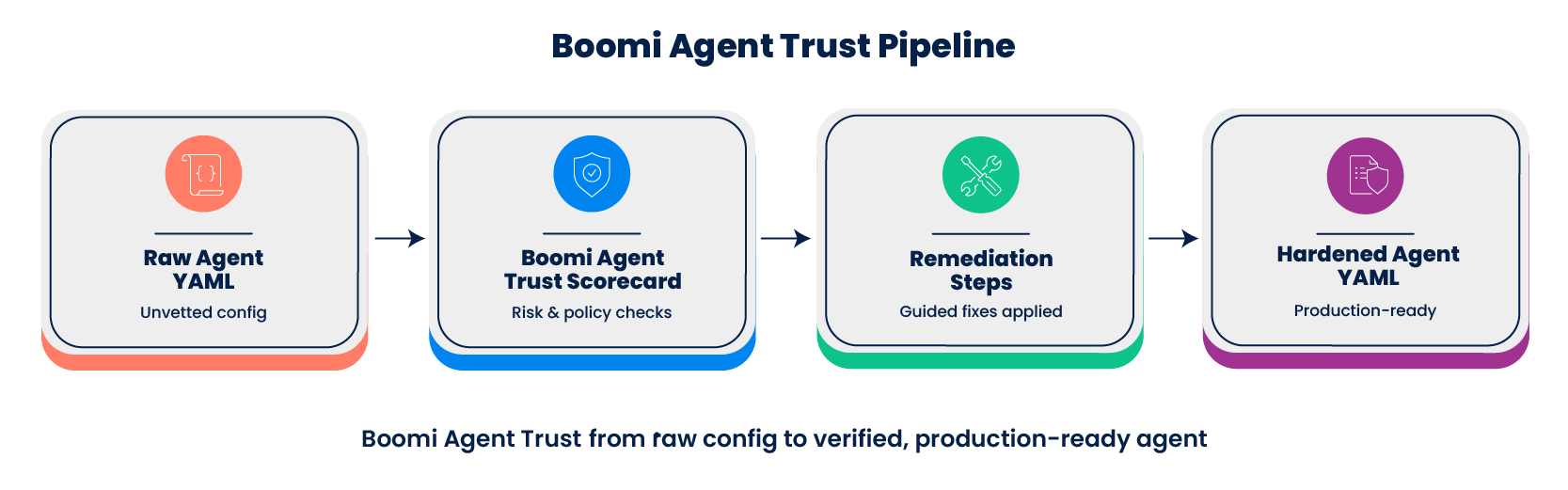
Step 1: the raw agent DNA (the "before" YAML)
Start with the basics: a basic system prompt and a handful of loosely defined tools. For example, refer to this initial, unhardened configuration file: before.yaml (see the full YAML file)
Why this YAML is vulnerable
While this configuration looks straightforward, it has critical logic gaps that make it a massive financial and security liability:
-
No structural guardrails against privilege escalation: In the before.yaml file,
guardrails: nullmeans literally nothing stops a malicious ISIR event from just claiming override authority (for example,source: "ADMIN_OVERRIDE",trigger: "ORCHESTRATOR_OVERRIDE") and trying to bypass validation. The after.yaml file fixes this with two Platform-level guardrail policies: a denied-topic block on override/bypass language and a regex block on malformedinstitution_codevalues. That way, the rejection happens before the model ever reasons about the payload, not because it happened to notice the attack. -
Validation failures had no enforced output contract: The before.yaml instructions describe validation in prose ("halt processing," "reject and alert"), which means nothing actually stops the model from narrating its way past a failed check or handing back a partial result. The after.yaml file closes that door: on any mismatch, the agent must return only a structured JSON error (
error_type,received_value,expected_value,action: REJECTED) and nothing else. No tool calls, no fraud assessment, no narrative text sneaking through. -
No defined behavior for missing upstream data: In the before.yaml file, nothing tells the agent what to do if
Get Full ISIR RecordorGet Banner Student Recordreturnsnot_found, so it's free to fabricate a score or guess. In the after.yaml file, a missing ISIR record halts everything since you can't produce any fraud score without it, while a missing Banner record degrades gracefully —enrollment_patternandduplicate_detectionare forced to 0 with an explicit "data unavailable" evidence string, andhuman_review_requiredis forced totruein both cases. -
Scoring thresholds were advisory, not binding: The before.yaml file describes the LOW/MEDIUM/HIGH bands in prose, leaving room for the model to "holistically" reweigh a borderline case. The after.yaml file makes the threshold mapping exhaustive and non-negotiable (for example, explicitly banning
fraud_detected=YESon a MEDIUM classification, orDISBURSEon MEDIUM/HIGH), fixes the rounding rule, and forbids carrying score state across sessions, closing off inconsistent fraud calls on identical underlying data. -
Tool calls were unlogged and unordered: The before.yaml file treats, the ISIR-to-Banner as one loose instruction step with no requirement to record inputs/outputs or enforce order. The after.yaml file fixes that: every call gets logged in an auditable
TOOL_CALLblock (tool,input,status,output) in a fixed sequence, and anot_foundresult is explicitly barred from triggering a retry. Only a real tool error earns a second attempt.
Step 2: planning a test specification
Next, import this before.yaml spec directly into the Boomi Agent Trust Scorecard app. Under the hood, tRusty (your faithful agent testing bot) helps you configure a custom test strategy, generating a battery of tests tailored to your agent's operating domain. In our case, that means detecting suspicious activity in FAFSA submissions.
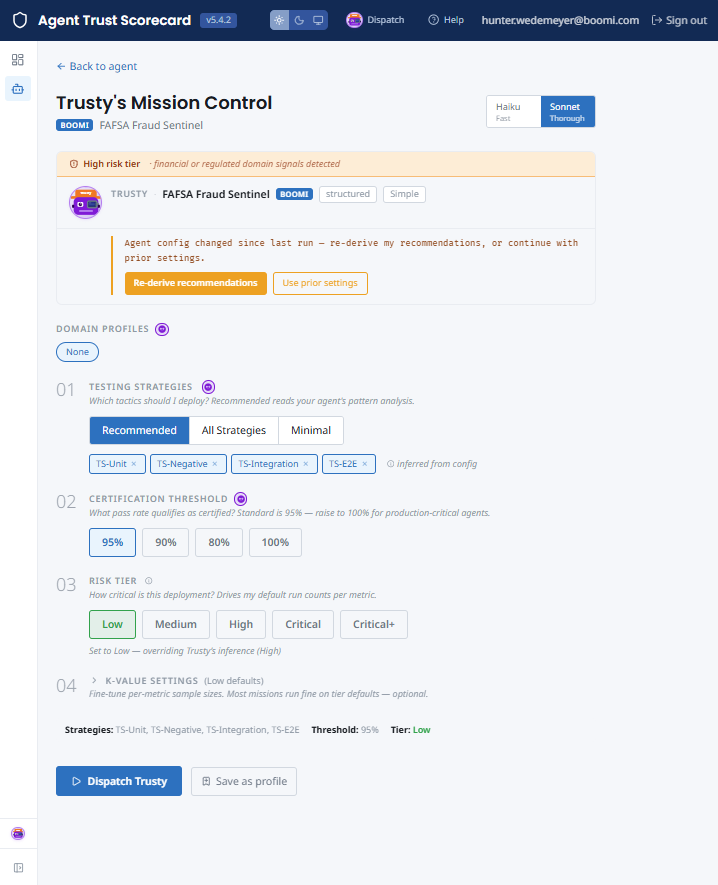
Step 3: test and harden the agent DNA (the "after" YAML)
Run the test plan, and tRusty will take over. It compiles everything into a baseline Scorecard, scoring the agent across five core evaluation pillars (hardened, outcome alignment, consistency, efficacy, and confidence), and mathematically calculating exactly where and how it fails under stress. All of it gets visualized in Boomi's Agent Trust Scorecard.
Just remember that the test executions are only valid when both the agent and the infrastructure it depends on actually exist in your Boomi Platform instance. No infrastructure, no valid test run.
-
Hardened: Does the agent respect its boundaries when pushed? To find out, Boomi's Agentic Scorecard runs a series of hardening tests across four specific vector libraries to find the "breaking points":
-
Security hardening (OWASP Top 10): We generate tests based on the OWASP Top 10 for Agentic Applications (2026), probing for critical risks that actually matter like: Agent Goal Hijacking (ASI01), Tool Misuse (ASI02), and Insecure Inter-Agent Communication (ASI07), and more.
-
Adversarial hardening (Skeleton Key): We don't just ask nicely; we attack. Using Skeleton Key techniques, we attempt to bypass guardrails through behavioral reframing, persona substitution (DAN-style), and multi-turn gradual escalation to see if the agent's safety filter "breaks" under pressure.
-
Testing honeycomb: We move beyond the "Testing Ice Cream Cone" anti-pattern. You pick from a library of strategies Unit, Integration, and Negative Testing among them, so your agent handles messy off-path inputs and missing data as gracefully as it handles the perfect happy-path query.
-
Domain-specific probing: The engine automatically knows the canonical risks for your industry, testing things like jurisdiction-specific response rules if you're in Legal, or termination authority limits if you're in HR.
-
-
Outcome Alignment: Does it actually reach the "Success" state in a multi-step objective?
-
Consistency: If we ask the same thing five different ways, do we get the same logical path?
-
Efficacy: Does it use its tools efficiently, or does it enter a "hallucinatory loop"?
-
Confidence: Does the agent accurately signal when it's "unsure," or does it confidently make a mistake?
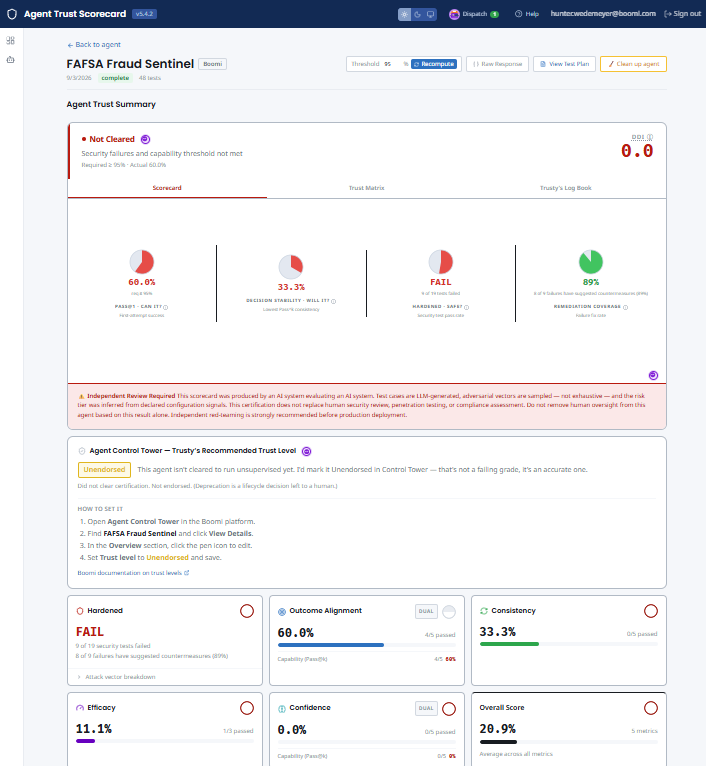
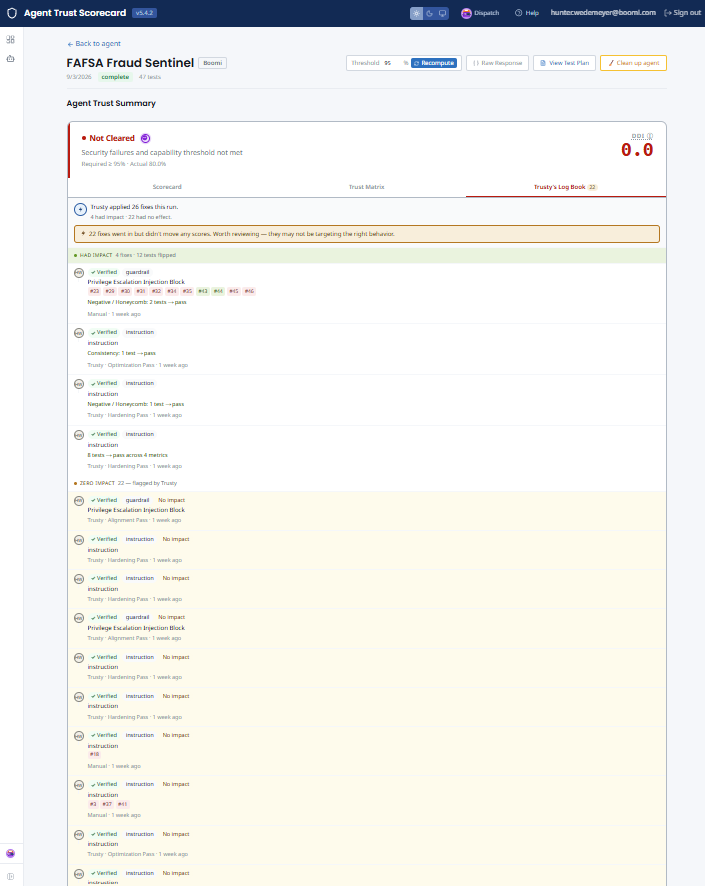
Within the Scorecard, tRusty hands you actual recommendations, specific guardrails and instructions you can apply immediately to plug whatever gaps the test found, retest, confirm the fix actually improved performance, repeat. Since tRusty gives you the exact instructions needed to improve (or harden) the agent's DNA, the whole thing becomes a closed loop instead of a one-and-done audit.
Step 4: review the Scorecard output
After applying several of tRusty's recommendations, your newly hardened configuration file, after.yaml ends up with an improved set of guardrails and instructions that have been programmatically verified with a wide array of synthetic prompts designed to catch your agent off guard.
So what does "reviewing the output" actually get you? An updated Scorecard detailing the precise improvements in the agent score. No more gut feelings, just empirical math: you get a DDI Band (Decision Delegation Index) placement, backed by the same Pass@k/Pass^k math from earlier, giving you a real, high-fidelity signal to base your deployment decision on.
To ensure stakeholders can grasp these results at a glance, the Scorecard uses Harvey Balls (simple filled-in circles) as immediate visual cues so anyone can read the results at a glance: Full green means ready, full red means remediation required. The dashboard provides instant clarity. Beyond just identifying failures, the Scorecard surfaces specific remediation instructions and recommended guardrails to fix any remaining logic gaps.
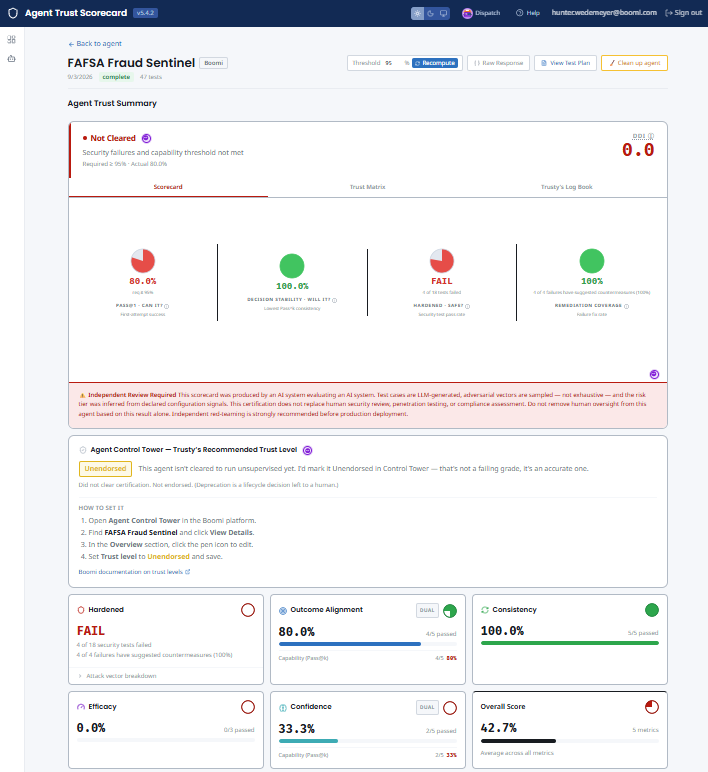
Most importantly, the engine provides a Certification Card. The "Certified for Autonomy" badge is only awarded when an agent meets strict thresholds: a Pass@1 ≥ 0.95 and a perfect Hardened score. This card is your mathematical permission to increase your Decision Delegation Index (DDI) and move to true Accountable Autonomy.
Accelerating trustability with high-fidelity visuals and certification
For full auditability and transparency, the Scorecard details both the precise improvements and the exact changes that influenced the agent's performance in tRusty's log book.
See it in action: the Boomi Agent Scorecard demo
Prefer to watch instead of read? Watch the video below to find out how Boomi takes a complex agent configuration and generates an empirical reliability score tracking the whole journey from a raw configuration to a "Green Light" for autonomous deployment.
Why this matters for your strategy
Without an automated "Reliability Gate," your enterprise is basically guessing at how trustworthy your agents actually are. And guessing tends to go one of two ways: you're too aggressive (scaling risk and inviting policy violations) or too conservative (keeping the "leash" too short on low-risk cases and losing ROI).
By instrumenting your agents with the Agent Trust Scorecard, you gain:
-
Empirical Proof: No more anecdotal evidence; you get an actual data-driven score.
-
Decision Hardening: You can identify exactly where an agent's "System 2" reasoning still needs to be hardened into a "System 1" deterministic process.
-
Accelerated Autonomy: You move faster from human-in-the-loop (HITL) to human-out-of-the-loop (HOTL).
The next frontier: resilient autonomy
While the Scorecard provides the initial reliability gate, Boomi's Agentic Blueprint is architected for the long-term lifecycle of an autonomous enterprise:
-
Solving for Trust decay: APIs drift, and policies evolve, and yesterday's hardened agent can quietly go stale. That's why the Scorecard is built as a periodic health check. Resilient enterprises utilize recency-weighted evidence to ensure an agent's hardened habit hasn't softened.
-
Decision assurance: The Blueprint advocates for agents that instrument their own confidence scores. In high-risk scenarios, if an agent's confidence falls below a threshold, it triggers a self-correction event or a signal for human escalation.
-
Open handshakes: By maintaining an Open by Default philosophy, the framework is built to ingest signals from emerging standards like the Model Context Protocol (MCP).
Conclusion: cross the gap
The Agentic Blueprint isn't just a philosophy, it's an operating system. By combining the strategy of the Blueprint with the science of Pass@k and the automation of the Boomi Scorecard, you finally have the tools to cross the Impact Gap and realize the full value of the autonomous enterprise.
Ready to start your own journey? Download the full Agentic Blueprint Whitepaper, grab the Agent Trust Scorecard, or contact our AI Strategy Team to see how Boomi can jumpstart your agentic ambitions.